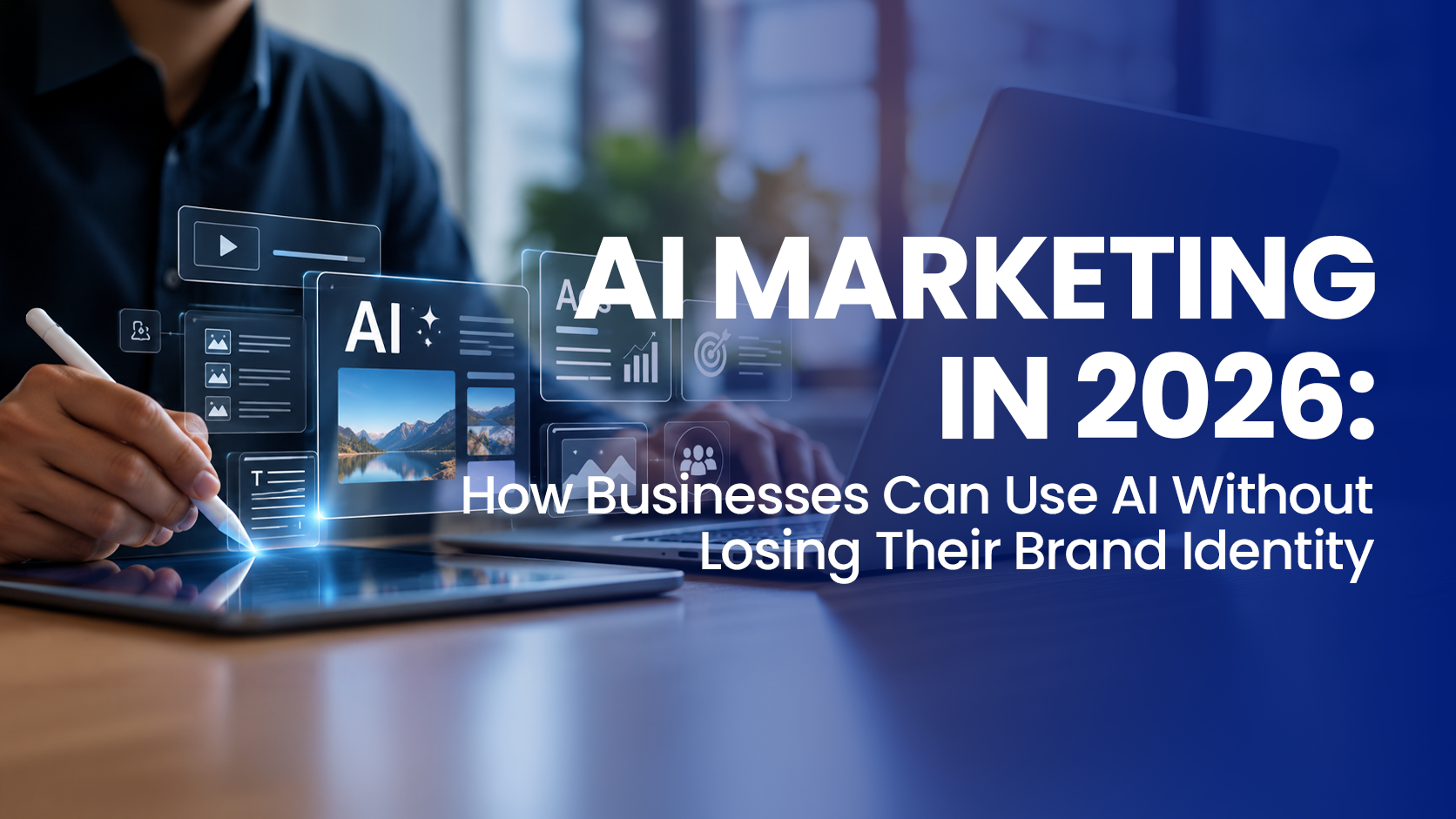
AI Marketing in 2026: How Businesses Can Use AI Without Losing Their Brand Identity
Artificial intelligence has quickly become part of the modern marketing landscape. From generating content ideas and analysing customer behaviour to automating campaigns and creating visuals, AI is helping businesses work faster and make more informed decisions.
But there is one important question businesses need to consider: How can you use AI effectively without making your brand feel generic?
In 2026, successful AI marketing is not simply about using more AI tools. It is about combining technology with human creativity, brand strategy and a clear understanding of your audience.
What Is AI Marketing?
AI marketing refers to the use of artificial intelligence technologies to support different areas of marketing, including content creation, customer insights, advertising, personalisation and automation.
Businesses can use AI to:
Analyse large amounts of customer and campaign data
Identify audience trends and behaviours
Generate content ideas and first drafts
Personalise customer experiences
Automate repetitive marketing tasks
Support advertising optimisation
Assist with creative development
Improve customer communication
The biggest advantage is efficiency. Tasks that previously required hours of manual work can often be completed much faster with the right AI-assisted workflow.
However, speed alone does not create a strong brand.
Why Brand Identity Still Matters
Your brand is more than your logo, colours or typography. It represents how your business communicates, what it stands for and how customers recognise and remember it.
If every business uses AI to produce similar captions, visuals and marketing messages, brands can quickly start to look and sound alike.
That is why businesses should treat AI as a creative and strategic assistant, rather than allowing it to define the entire brand.
Your brand should still have:
A distinct voice
Consistent visual language
Clear positioning
Original ideas
Strong storytelling
A defined target audience
Human experiences behind the content
AI can help you produce content faster, but your brand strategy determines what should be created and why.
1. Use AI for Ideas, Not Just Content
One of the most useful applications of AI is brainstorming.Instead of asking AI to create generic social media posts, businesses can use it to explore:
Campaign concepts
Content themes
Customer pain points
Blog topics
Video concepts
Advertising angles
Frequently asked questions
Seasonal campaigns
The marketing team can then select, refine and develop the ideas that actually fit the brand.
This creates a better workflow:
AI generates possibilities → Humans select the direction → Creative teams develop the idea → Brand strategy shapes the final output.
2. Keep Your Brand Voice Consistent
AI-generated content can sometimes sound repetitive or overly generic.For example, phrases such as "take your business to the next level" or "unlock your potential" can appear across thousands of pieces of marketing content.Businesses can reduce this problem by establishing clear brand guidelines.Your guidelines can define:
Tone of voice
Words to use
Words to avoid
Writing style
Brand personality
Communication principles
Visual direction
Audience preferences
AI can then be used within those boundaries rather than creating content without context
3. Combine AI With Human Creativity
AI can analyse patterns and generate ideas quickly, but human creativity remains important for developing meaningful campaigns.A strong campaign often starts with understanding:Who is the customer?
What problem do they have?
What do they care about?
What makes this brand different?
What action should the customer take?Technology can assist with the process, but these questions require strategy.The strongest approach is not AI vs creativity.
It is:
AI + Strategy + Creativity + Human Insight.
4. Personalisation at Scale
Personalisation is another major opportunity for AI marketing.Instead of communicating with every customer in exactly the same way, businesses can use data and AI-assisted tools to create more relevant experiences.For example, an e-commerce brand may show different product recommendations based on browsing behaviour.A B2B company may create different content for business owners, marketing managers and procurement teams.An education company may communicate differently with students, parents and corporate clients.
The goal is not to create more content simply for the sake of volume.
The goal is to deliver more relevant content to the right audience.
5. AI Can Make Advertising More Efficient
Digital advertising platforms are increasingly using AI and machine learning to optimise campaigns.Businesses can use AI-assisted advertising workflows to help with:
Audience analysis
Creative testing
Campaign optimisation
Budget allocation
Performance analysis
Conversion insights
Predictive recommendations
But businesses should not completely remove human oversight.
Marketing teams still need to monitor campaign quality, lead quality, messaging and customer feedback.
A campaign generating a large number of leads is not necessarily successful if those leads are not relevant.
6. Don’t Let AI Replace Your Brand Story
One of the biggest mistakes businesses can make is allowing AI to create everything.Your customers don't only want information. They want to understand why your business exists, what you offer and why they should trust you.That story comes from your people, experiences, customers, projects and values.Instead of asking AI to invent a brand story, give it real information:
Customer testimonials
Project results
Team experiences
Product information
Comp
What Should Businesses Do Before Investing in ChatGPT Ads?
Strengthen your website
Your website should clearly communicate:
What you offer
Who you serve
Where you operate
Why customers should consider you
How customers can contact you
Build useful content
AI-powered discovery increases the importance of content that answers real customer questions.
Create content around:
Common customer problems
Service comparisons
Buying guides
Frequently asked questions
Industry trends
Pricing considerations
Location-specific questions
Improve your SEO and GEO strategy
Search engine optimization remains important, but businesses should also consider Generative Engine Optimization (GEO).
The objective is to make your business information clear, structured and useful across AI-driven discovery experiences.
That includes maintaining accurate business information, creating authoritative content, implementing relevant structured data and building a strong digital presence.
Define your customer intent
Instead of asking only:
"What keyword should we target?"
marketers should also ask:
"What is the customer trying to achieve?"
For example, a business selling corporate gifts might target different conversational needs such as:
Corporate gifts for employees
Branded gifts for events
Custom promotional products
Bulk corporate gifting in Dubai
Each represents a different customer intent.
ChatGPT Ads Are Now Available in the UAE
ChatGPT Ads are now available to eligible advertisers in the UAE, giving businesses a new way to reach potential customers while they research, compare options and explore products or services through ChatGPT.
For UAE businesses, this creates an opportunity to add AI-powered advertising to their existing digital marketing strategy alongside Google Ads, Meta Ads and SEO.
Because ChatGPT is a conversational platform, businesses can focus not only on keywords but also on customer intent, context and the problems customers are trying to solve.
How Kreativefolio Can Help
Kreativefolio can help UAE businesses plan, launch and optimize their ChatGPT Ads campaigns, including:
Contains information related to marketing campaigns of the user. These are shared with Google AdWords / Google Ads when the Google Ads and Google Analytics accounts are linked together.
90 days
__utma
ID used to identify users and sessions
2 years after last activity
__utmt
Used to monitor number of Google Analytics server requests
10 minutes
__utmb
Used to distinguish new sessions and visits. This cookie is set when the GA.js javascript library is loaded and there is no existing __utmb cookie. The cookie is updated every time data is sent to the Google Analytics server.
30 minutes after last activity
__utmc
Used only with old Urchin versions of Google Analytics and not with GA.js. Was used to distinguish between new sessions and visits at the end of a session.
End of session (browser)
__utmz
Contains information about the traffic source or campaign that directed user to the website. The cookie is set when the GA.js javascript is loaded and updated when data is sent to the Google Anaytics server
6 months after last activity
__utmv
Contains custom information set by the web developer via the _setCustomVar method in Google Analytics. This cookie is updated every time new data is sent to the Google Analytics server.
2 years after last activity
__utmx
Used to determine whether a user is included in an A / B or Multivariate test.
18 months
_ga
ID used to identify users
2 years
_gali
Used by Google Analytics to determine which links on a page are being clicked
30 seconds
_ga_
ID used to identify users
2 years
_gid
ID used to identify users for 24 hours after last activity
24 hours
_gat
Used to monitor number of Google Analytics server requests when using Google Tag Manager
1 minute
Google reCAPTCHA helps protect websites from spam and abuse by verifying user interactions through challenges.
Name
Description
Duration
_GRECAPTCHA
Google reCAPTCHA sets a necessary cookie (_GRECAPTCHA) when executed for the purpose of providing its risk analysis.
179 days
Marketing cookies are used to follow visitors to websites. The intention is to show ads that are relevant and engaging to the individual user.
OpenAI Ads Pixel tracks website conversions from ads shown in ChatGPT, helping advertisers measure and optimize their ad campaigns.
Stores a privacy-preserving click reference captured from an ad landing page URL, so later page views on the site can be matched back to the ad click for conversion measurement.
30 days
__oaiq_consent
Remembers whether the visitor has granted or denied consent for ad measurement, so the pixel does not need to ask again on later page views.
30 days
__obref
Stores a randomly generated browser identifier used to measure and deduplicate ad conversions across page views.